
Podcast Link:
MAL Season 3, Episode (1) (1/7/24)
Word of the week-
Commence:
To commence is to get started with something. It comes from the old French word comencier.
Quotable Quotes:
“The way to get started is to quit talking and start doing.”
Walt Disney
Literary Device:
Let’s talk about Literary Devices! Writers use techniques to create specific effects, enhance their writing, or add meaning to their text. We call these literary devices. Starting next week, we’ll explore various techniques each week used by writers to help improve their writing.
Highlight of the Week:
Each week, we’ll explore highlights of writing, such as software, resources, news and more! This week’s highlight:
Plottr: Are you looking for a way to organize your writing? Check out Plottr! This software tool can help you to outline your writing and stay organized as you write a book! With visual overviews, and premade template options, Plotter can help you get organized, build your fictional world and develop characters. Check it out today, with the link in the description.
You can visit the Plottr website here: Features – Plottr
Reading- 5 Opening Lines
A great opening line can draw your reader in and encourage them to keep reading. Here are 5 Opening Lines from well known authors:
- Emma by Jane Austen “Emma Woodhouse, handsome, clever, and rich, with a comfortable home and happy disposition, seemed to unite some of the best blessings of existence; and had lived nearly twenty-one years in the world with very little to distress or vex her.” The Project Gutenberg eBook of Emma, by Jane Austen
- Oliver Twist by Charles Dickens “Among other public buildings in a certain town, which for many reasons it will be prudent to refrain from mentioning, and to which I will assign no fictitious name, there is one anciently common to most towns, great or small: to wit, a workhouse; and in this workhouse was born; on a day and date which I need not trouble myself to repeat, inasmuch as it can be of no possible consequence to the reader, in this stage of the business at all events; the item of mortality whose name is prefixed to the head of this chapter.” The Project Gutenberg eBook of Oliver Twist, by Charles Dickens
- Treasure Island by Robert Louis Stevenson: “QUIRE TRELAWNEY, Dr. Livesey, and the rest of these gentlemen having asked me to write down the whole particulars about Treasure Island, from the beginning to the end, keeping nothing back but the bearings of the island, and that only because there is still treasure not yet lifted, I take up my pen in the year of grace 17__ and go back to the time when my father kept the Admiral Benbow inn and the brown old seaman with the sabre cut first took up his lodging under our roof.” The Project Gutenberg eBook of Treasure Island, by Robert Louis Stevenson
- Anne of Green Gables by L.M. Montgomery: “MRS. Rachel Lynde lived just where the Avonlea main road dipped down into a little hollow, fringed with alders and ladies’ eardrops and traversed by a brook that had its source away back in the woods of the old Cuthbert place; it was reputed to be an intricate, headlong brook in its earlier course through those woods, with dark secrets of pool and cascade; but by the time it reached Lynde’s Hollow it was a quiet, well-conducted little stream, for not even a brook could run past Mrs. Rachel Lynde’s door without due regard for decency and decorum; it probably was conscious that Mrs. Rachel was sitting at her window, keeping a sharp eye on everything that passed, from brooks and children up, and that if she noticed anything odd or out of place she would never rest until she had ferreted out the whys and wherefores thereof. Anne of Green Gables | Project Gutenberg
- War of the Worlds by H.G. Wells: “No one would have believed in the last years of the nineteenth century that this world was being watched keenly and closely by intelligences greater than man’s and yet as mortal as his own; that as men busied themselves about their various concerns they were scrutinised and studied, perhaps almost as narrowly as a man with a microscope might scrutinise the transient creatures that swarm and multiply in a drop of water. “ The Project Gutenberg eBook of The War of the Worlds, by H. G. Wells
About each of the books listed above: This eBook is for the use of anyone anywhere in the United States and most other parts of the world at no cost and with almost no restrictions whatsoever. You may copy it, give it away or re-use it under the terms of the Project Gutenberg License included with this eBook or online at www.gutenberg.org. If you are not located in the United States, you will have to check the laws of the country where you are located before using this eBook.
Tips on Getting Started with a Story:
Getting started with a story can be challenging, but having a strong beginning can really draw the reader in and keep them reading. Here are 9 Tips on getting started with a story.
- Write a strong beginning sentence! You want an opening line that can grab the reader’s attention.
- Organize any research you do. You’ll want to be able to cite your work, and have a quick reference.
- Decide what genre your writing will be in. This will impact the mood, setting, and where your story is going to go.
- Build a strong writing habit. Writing every day is a great goal, but if it’s not realistic to your current situation, change the goal for the times you are able to write. Carve out time every week to write, and stick with it to build strong writing habits! Show up even when it’s tough.
- Be careful not to info dump. In some genres, you may need to world build more than others at the start, but too much information and not enough action will leave your reader bored.
- Just write. Some days you may not feel like writing, but get started anyways. You can always start with repeating the phrase “I’m writing” until full sentences begin to come to you.
- Go easy on the number of characters you have, especially at first. Slowly introduce characters so you don’t overwhelm the reader.
- Make the conflict big enough to be worth it. Smaller conflicts can be a part of the story as well, but if the conflict is too small or non-existent, you won’t have much of a story to tell.
- Include an incident early on that drives the action forward to draw the reader in.
Prompt:
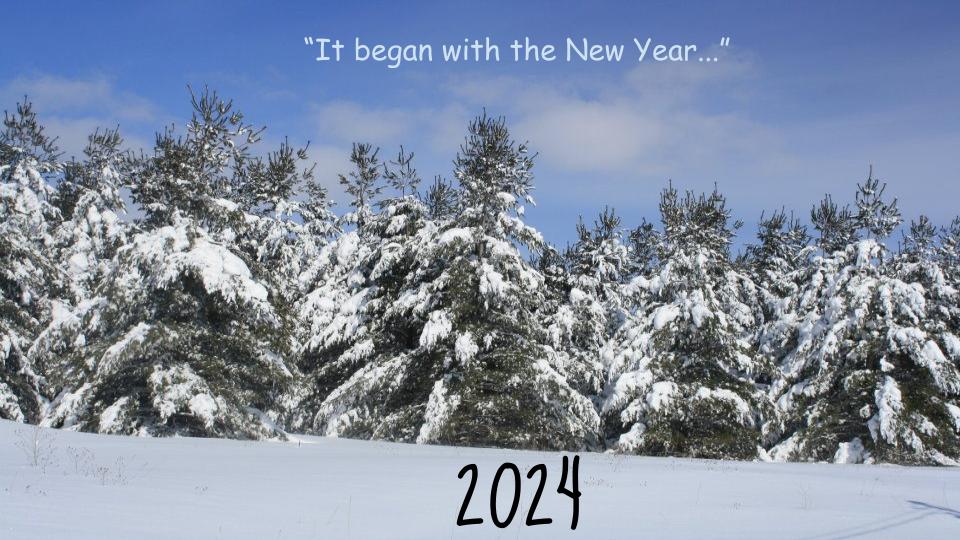
Finish the story: “It began with the New Year.”
 My A-muse-ing Life
Leave a comment